
Should Your Business Build Custom Software?

Alai Partners works with businesses across multiple industries to identify, develop, and implement AI opportunities. One pattern has become increasingly clear: …
Alai Partners works with businesses across multiple industries to identify, develop, and implement AI opportunities. One pattern has become increasingly clear: many companies are asking how to use AI, when the bigger opportunity is deciding where technology can create the most value.
Everyone is talking about AI agents, copilots, and automation. Business leaders are being told to adopt AI, but many are still asking the same question:
Where do I actually start?
Creating custom software is now faster, more affordable, and more accessible than ever before. What once required a large engineering team, significant capital, and months or years of development can now be accomplished in a fraction of the time. Businesses of all sizes now have the opportunity to build technology that was previously out of reach.
Of course, that doesn’t mean every business should invest in custom software. Off-the-shelf platforms solve real problems and continue to be the right choice for many organizations.
The opportunity today is that custom software has become a realistic option for far more businesses than ever before. That leaves companies with a decision: buy or build?
Buying vs. Building
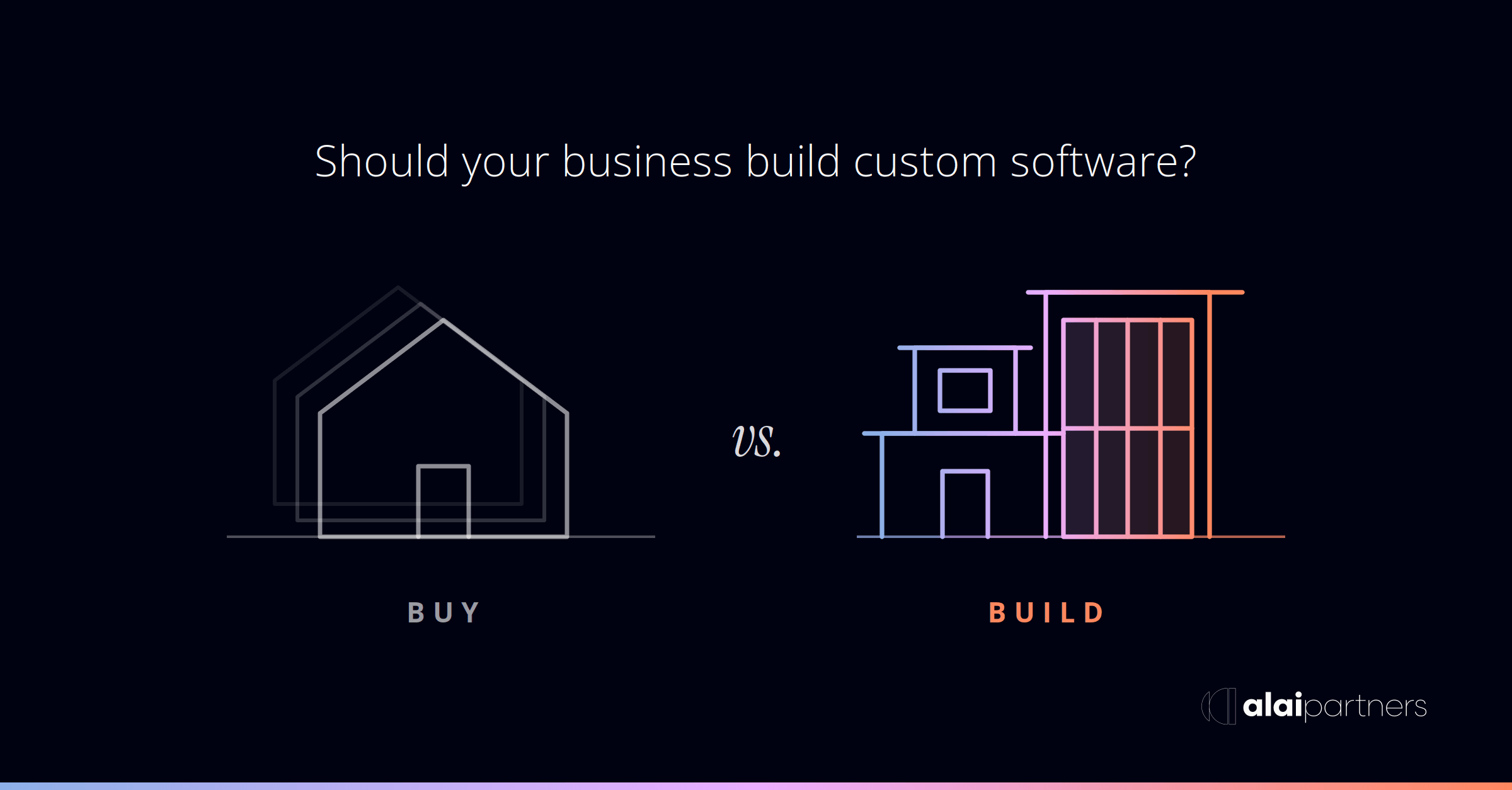
Think about buying a home.
For most people, purchasing an existing home is the right decision. It is faster, less expensive upfront, and meets their needs.
Building a custom home requires more planning and a larger initial investment. In return, you get a home designed specifically for your family, your lifestyle, and your long-term goals.
Software is no different.
Off-the-shelf software is built to serve thousands of companies. That means it works well for common business needs, but it also means every company is expected to adapt its processes to fit the software.
Custom software flips that relationship. Instead of changing your business to fit the technology, the technology is built around the way your business operates.
Neither approach is inherently better. The right choice depends on your business and the problems you’re trying to solve and/or the solutions you bring to customers.
When Does Custom Software Make Sense?
We’ve noticed a few common patterns among companies that benefit most from custom software.
1. Your business has unique processes that create value.
Every business has processes. Some are standard across an industry, while others are part of what makes the business unique and successful.
If your team constantly works around software limitations, maintains spreadsheets outside your core systems, or has developed unique workflows that create a competitive advantage, generic software may never be a perfect fit.
Your differentiators deserve technology that supports them instead of constraining them.
2. Your operations are spread across too many systems.
Many businesses don’t have a software problem. They have a fragmentation problem.
Data lives in one platform. Documents live somewhere else. Employees manually move information between systems. Teams spend time searching instead of working.
In many cases, the opportunity isn’t replacing existing software. It’s creating an integration layer that connects everything together, automates repetitive work, and gives your team one place to manage critical information.
3. The return on investment is clear.
Custom software should be treated like any other investment.
If a solution can eliminate repetitive digital work, reduce software licensing costs, improve decision making, increase throughput, or create a better customer experience, the long-term value can easily outweigh the upfront investment.
The goal should never be building software for the sake of building software. The goal is creating measurable business value.
When Off-the-Shelf Software Is the Better Choice
Custom software is not always the answer.
If your processes are changing every month, it may be worth waiting until they stabilize before investing in technology.
If your needs are already met by an existing platform, there is little reason to build your own (assuming fair pricing and reasonable onboarding process).
If the expected return of custom software doesn’t justify the cost, your investment is probably better spent elsewhere.
Sometimes the best technology decision is adopting an existing platform and moving on.
Questions Every Business Leader Should Ask
If you’re considering custom software, start with these questions:
Are people spending significant time on repetitive digital work?
Have you ever said, “I wish there was software that could…”?
Are multiple systems creating unnecessary friction or duplicate work?
Does this process give our business a competitive advantage?
Would solving this problem save enough time or money to justify the investment?
Are we paying for multiple tools that could reasonably become one?
If you answer “yes” to several of these questions, custom software may be worth exploring.
What We’ve Seen in Practice
We’ve had the opportunity to help organizations solve a variety of business challenges with custom technology.
One client wanted to make decades of machine knowledge easily accessible to technicians and engineers. We built an intelligence platform around their proprietary documentation, letting employees troubleshoot equipment using their own institutional knowledge instead of generic online resources. The platform paid for itself within two weeks of going live.
Another client needed to process 20,000+ utility bills each month. Rather than relying on generic OCR software, we built a custom document intelligence platform that extracts the information they need and integrates directly into their downstream systems. The platform now saves more each year than it cost to build.
Neither project started with “We want AI.”
Both started with a business problem. Custom technology simply became the best solution.
Final Thoughts
The barriers to building great software have never been lower. Businesses no longer have to settle for “good enough” systems or assume custom software is reserved for the largest enterprises.
Every business has opportunities to improve the way it operates. Some are best solved with existing software. Others are worth building yourself.
If you’ve ever had an idea that could improve your business, there has never been a better time to build it.